Location file
Whitehaven: The Best Beach In The World?
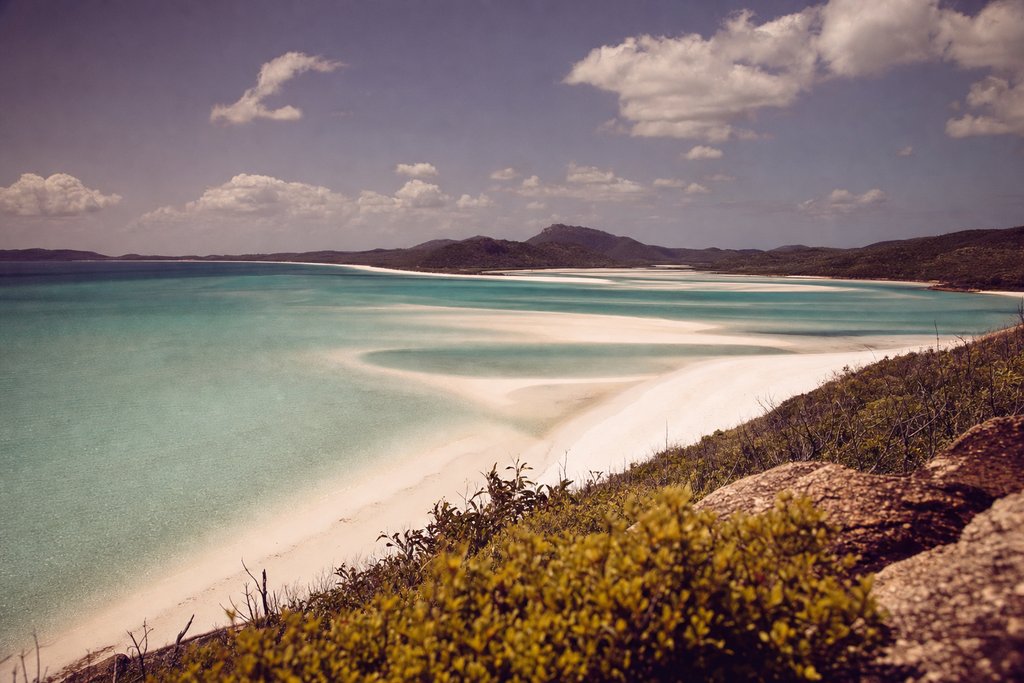
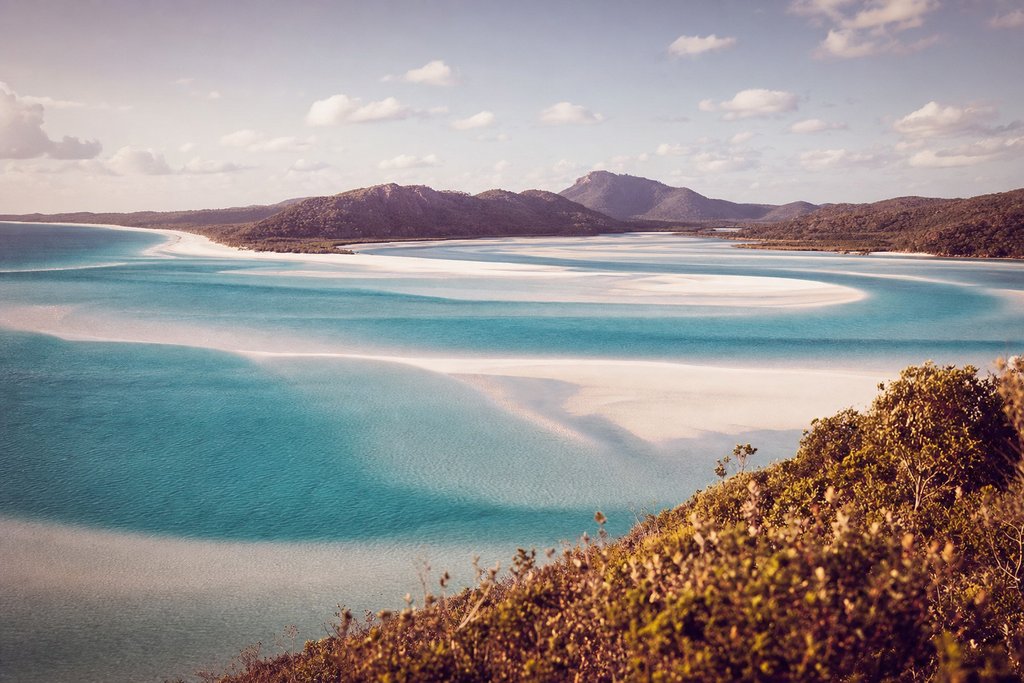
Whitehaven is seven kilometres of almost pure silica sand on an uninhabited national park island, and the first thing to understand about visiting it is that the two images people arrive with are of two different places. The long empty white beach is Whitehaven. The blue-and-white swirl is Hill Inlet, seen from a lookout on a headland above it. They are at opposite ends and not every trip includes both.
Getting there
There is no road and no accommodation on the island. Every visit is a day trip from one of three departure points:
| From | By | Typical time each way |
|---|---|---|
| Airlie Beach / Port of Airlie | Boat | 1.5–2 hours |
| Shute Harbour | Boat | 1–1.5 hours |
| Hamilton Island | Boat or seaplane | 45 min / 15 min |
Seaplane and helicopter trips are shorter, considerably more expensive, and give the aerial view of Hill Inlet that boat trips cannot. Several combine a flight one way with a boat the other, which is the best value version of the aerial option.
The two ends of the beach
Whitehaven Beach, southern end
The long open beach. Fine, blindingly white sand, shallow clear water, and, because the sand is silica, not crushed coral or quartz, it stays cool underfoot even in full sun and squeaks when you walk. Most boat trips land here for two to four hours.
There are composting toilets and picnic shelters at the southern end and nothing else: no kiosk, no shade beyond the treeline, no drinking water. Everything comes with you and leaves with you.
- Address
- Whitsunday Island, Whitsunday Islands National Park, Queensland
- Status
- Standing
- Access
- Boat or air only; national park
- Checked
- Aug 2026
Hill Inlet lookout, northern end
The lookout is reached from Tongue Bay, on the other side of the headland, by a graded walking track of about twenty to thirty minutes with a climb. The pattern below shifts with every tide, so what you see depends entirely on when you are standing there.
Not all trips include this. If the swirl is the reason you are going, check that the itinerary lands at Tongue Bay and allows time for the walk: several beach-only trips do not.
- Address
- Tongue Bay to Hill Inlet lookout, Whitsunday Island
- Status
- Standing
- Access
- Walking track from Tongue Bay landing
- Checked
- Aug 2026
Stinger season and swimming
Marine stingers are present in Queensland coastal waters roughly from November to May, and operators supply full-body suits during that period. Wearing one is not optional in the sense that matters: the risk is small but the consequence is serious, and the suits also solve the sun.
Outside that window the risk is much lower and suits are usually offered, not required. The water is warm year round and the beach shelves gently, so swimming is easy in both seasons.
Sun, and the specific problem here
White silica sand reflects sunlight upwards. The practical effect is that people burn on the undersides of their arms and chins, in places sunscreen is routinely missed, and burn faster than the air temperature suggests. There is no natural shade on the open beach.
Take more sunscreen than seems reasonable, a hat, and a long-sleeved layer. Queensland's UV index is extreme for most of the year and this beach amplifies it.
Choosing a trip
- Large catamaran day trips: cheapest, most people, usually the southern beach only. Fine if the beach is what you want.
- Small-boat trips: fewer passengers, usually both Tongue Bay and the beach, often with snorkelling. The best balance for most people.
- Seaplane or helicopter: the aerial view of the inlet, a short landing, and the highest price. Worth it specifically for the photograph.
- Overnight sailing: two or three days around the islands with Whitehaven as one stop, and the only way to be on the beach without other day trippers.
Rules worth knowing
It is a national park. Nothing is taken away, including sand; the silica is a protected part of the environment and removing it is an offence, quite apart from being a poor thing to do. Drones require permits. All rubbish leaves with you, and there are no bins.
When to go
The dry season, roughly May to September, has the settled weather, the clearest water and no stingers. It is also the busy and expensive period. The wet season from December to March brings rain, heat, stingers and the possibility of cyclones, and trips are cancelled at short notice.
Shoulder months (April to May, and October) are the compromise most people should take. The rest of the Australian material is in the Australia desk, and the other well-photographed coastal subject on this site is Sydney harbour. For the trip around it, travel tips covers the money and connectivity side.
Why the sand behaves the way it does
Whitehaven's sand is around ninety-eight per cent silica with a very fine, uniform grain. Two consequences follow, and both are noticeable within a minute of walking on it.
It stays cool underfoot in full sun, because silica reflects, and does not absorb, the heat that makes ordinary quartz or coral sand painful in the middle of the day. And it squeaks; the grains are so uniform that they slide against each other rather than packing, and the sound is audible.
Where it came from is unresolved. The surrounding islands are granite and the local rock does not weather to this composition, so the leading explanation is that the sand was carried here by ocean currents over a very long period. That is also part of the reason it is protected: it is not being replenished from anywhere nearby.
The two ends, in more detail
Boat trips land at one of two points and the difference matters more than the operator's description usually makes clear.
| Whitehaven, southern end | Tongue Bay / Hill Inlet | |
|---|---|---|
| What you get | The long open beach, swimming | The lookout over the swirl, then a short walk to the inlet |
| Effort | Step off the boat onto sand | 20–30 minute graded climb |
| Facilities | Composting toilets, picnic shelters | None |
| Best for | Swimming and the long empty view | The photograph everybody has seen |
A trip that includes only the southern end is not a bad trip; it simply does not include the view that most people booked for. Check the itinerary names Tongue Bay.
Tides
Hill Inlet is a tidal feature and the pattern changes completely across a cycle. A low outgoing tide gives the strongest separation of white sand and blue water; a high tide fills the channels and flattens the pattern. Operators schedule around it where they can and cannot always.
Whitsunday tidal range is substantial, so the difference between a good and an ordinary view of the inlet is a few hours rather than a few metres. Asking an operator what the tide will be doing at the time of the visit is a reasonable question and a good filter on how well they know their own product.
The wider Whitsundays
- Hamilton Island: the only island with an airport, and the shortest transfer to the beach.
- Airlie Beach: the mainland base, with the lagoon, the marina and most of the operators.
- Hayman, Daydream and Long islands: resort islands with day-visitor access varying by property.
- The outer reef: a separate, longer trip from Airlie, and a different experience from the inner-island snorkelling.
Cyclones, closures and refunds
The wet season from December to March brings heat, rain and cyclone risk, and trips are cancelled at short notice when conditions require it. That is not an operator failing; the passage between the islands is exposed and the decision is a safety one.
Two practical responses: book the beach trip early in a stay rather than on the last day, so there is room to rebook, and check the cancellation and refund terms before paying. Travel insurance that covers weather cancellation is worth more here than in most places on this site.
Frequently asked questions
Where is Whitehaven Beach?
On the eastern side of Whitsunday Island in the Whitsundays, off the central Queensland coast. It is inside a national park with no accommodation and no road access; every visit arrives by boat or seaplane from Airlie Beach, Shute Harbour or Hamilton Island.
Why is the sand at Whitehaven so white?
It is almost pure silica, around 98 per cent, with a very fine grain. That composition is why it stays cool underfoot in full sun and why it squeaks when you walk on it, and it is also why it should not be taken away.
What is Hill Inlet?
The tidal inlet at the northern end of the beach where the sand and water shift with each tide to produce the swirling pattern in the well-known photographs. It is seen from a lookout on the headland above, reached on foot from Tongue Bay, not from the beach itself.
Do you need to swim in a stinger suit?
From roughly November to May, yes. Marine stingers are present in Queensland waters in the warmer months and operators supply suits. Outside that window the risk is much lower but not zero.