Location file
Exploring History: Elfreth's Alley, Philadelphia
Elfreth's Alley is ninety metres long and takes fifteen minutes to walk. What makes it worth the detour is not its size but its continuity: thirty-two brick houses built between the 1720s and the 1830s that have been lived in continuously ever since, on a cobbled street barely wide enough for a cart.
It survived because it was unfashionable. The alley was built for tradesmen (shipwrights, pewterers, dressmakers) on a lane too narrow for the larger houses that replaced most colonial fabric elsewhere in the city, and by the time anyone thought it worth demolishing, residents had organised to keep it.
The street
Elfreth's Alley, off North 2nd Street
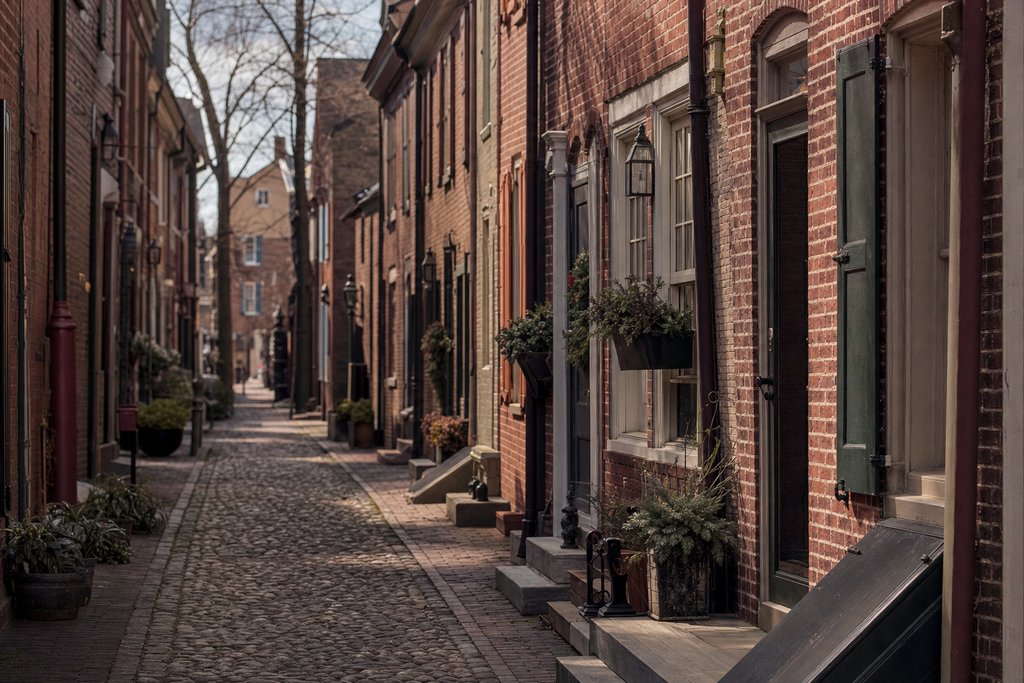
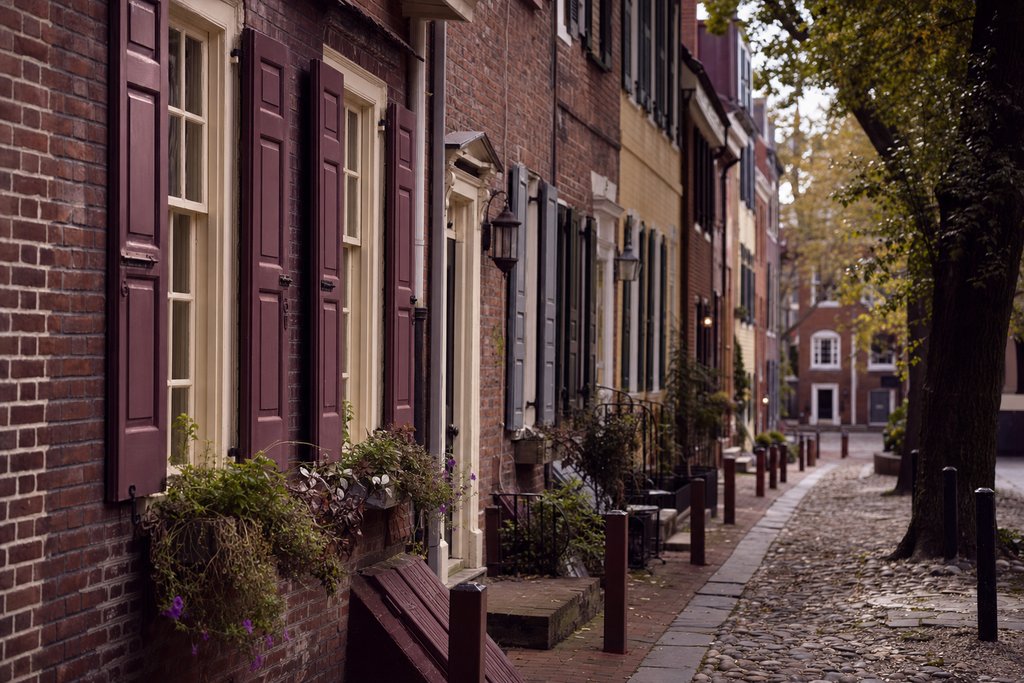
Two rows of brick houses facing each other across cobbles, most of them two and a half or three storeys, with panelled doors, shutters and the pent roofs typical of early Philadelphia building. Bladen's Court, a small paved courtyard, opens off the middle of the north side.
The houses are private homes with residents who live ordinary lives on a street that receives visitors all day. There is no barrier and no ticket for the street itself; there is also no reason to knock on a door, look through a window or sit on a step.
- Address
- Elfreth's Alley, off North 2nd Street, Philadelphia, Pennsylvania
- Status
- Standing
- Access
- Street open at all hours; houses private
- Checked
- Aug 2026
The museum houses, 124 and 126
Two of the thirty-two are run as a small museum by the residents' association, furnished to show how the houses were used by working families. Opening is limited and seasonal, often a few days a week and fewer in winter, so it is worth checking rather than assuming.
- Address
- 124–126 Elfreth's Alley, Philadelphia
- Status
- Standing
- Access
- Open on scheduled days, small admission
- Checked
- Aug 2026
On camera
The alley works as a standing double for colonial and early-federal Philadelphia, and it appears in period productions for the obvious reason: there is nothing to keep out of shot. No power lines, no parking, no modern shopfronts. It is listed in the USA master index for that reason rather than for any single film.
Filming here is tightly controlled and infrequent, because the residents have to agree to it and a street this narrow cannot absorb a crew without closing entirely.
When to go
Early morning, for two reasons. The alley runs roughly east to west and the light comes down it properly only in the first hours; and by mid-morning in summer it carries a steady stream of walking tours. At eight o'clock it is usually empty.
The residents' association runs open-house days once or twice a year when some of the private houses admit visitors. Those days are the only opportunity to see inside more than the two museum properties, and they are busy.
Fitting it into Old City
The alley sits four blocks from Independence Hall and two from the river, in a district that is walkable end to end in half an hour. A reasonable order:
- Elfreth's Alley first, early, while it is quiet.
- Christ Church and its burial ground, five minutes south.
- Franklin Court and the Betsy Ross House.
- Independence Hall and the Liberty Bell in the afternoon: Independence Hall needs a timed ticket for most of the year and the queue for the bell is longest at midday.
Practicalities
The cobbles are genuinely uneven and are hard going in unsuitable shoes or with a wheelchair; the footway is narrow and in places non-existent. There are no facilities on the alley itself.
Old City is served by the Market–Frankford line at 2nd Street, two minutes' walk away. Street parking in the district is metered, restricted and difficult; the garages on Market Street are the practical option. Philadelphia is an easy day trip by train from New York, about ninety minutes each way.
A note on how to behave here
This is the one entry in this index where the request is worth stating plainly. Thirty of the thirty-two houses are somebody's home, with a front door opening directly onto a street that several hundred people walk down every day. Photograph the street, do not photograph through windows, and do not sit on the steps. It is a small ask for a street that has stayed standing for three hundred years partly because the people in it fought for it.
The rest of the American files are in the United States hub, every address is filterable in the location index, and the practical layer for an American trip is in travel tips.
Who lived here
The alley was built as workers' housing on a lane cut through from Second Street to the waterfront, and its residents were tradespeople serving the port: shipwrights, sailmakers, pewterers, glassblowers, dressmakers, bakers. The houses are small because the plots were cheap and the tenants were not wealthy.
That is why the street survives. Grander colonial Philadelphia was demolished and rebuilt as the city's fortunes changed; a lane too narrow for a cart to turn in was never worth redeveloping. By the time anyone proposed clearing it in the 1930s, residents had organised to stop them, and the association they founded still owns the two museum houses.
What to look at
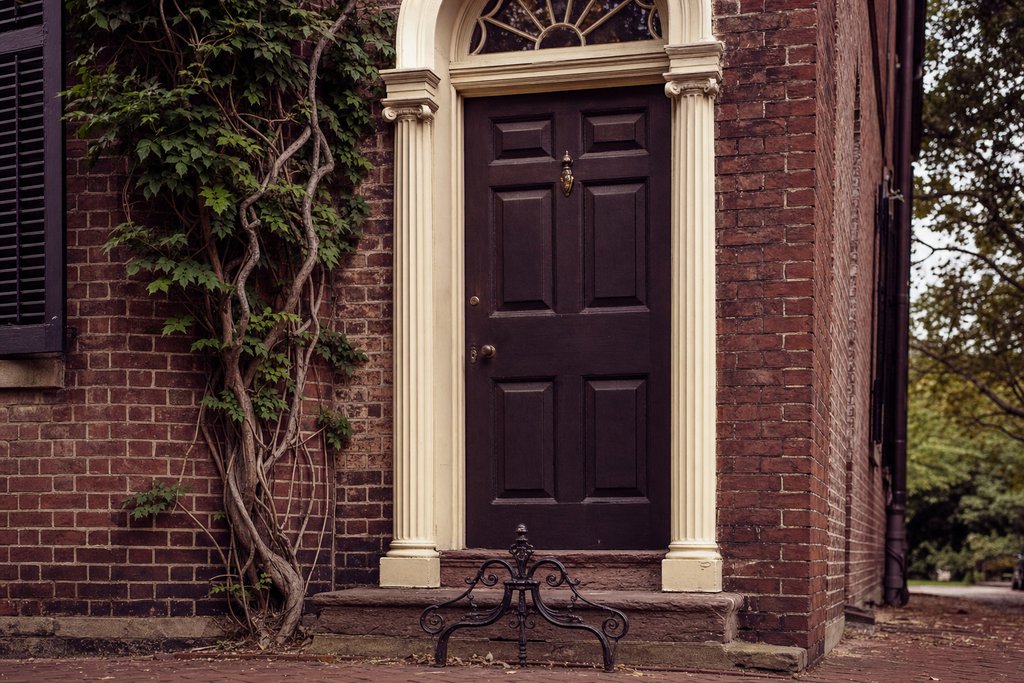
- The bootscrapers beside almost every door: iron blades set into the step, original street furniture from a time when the alley was mud.
- The pent roof, the small sloped roof over the ground-floor windows and door. A Philadelphia detail, and a practical one: it kept rain off open windows.
- Busybody mirrors at some upper windows: angled mirrors that let an occupant see who was at the door without going down.
- Bladen's Court, the small paved courtyard off the north side, which is where the density of this kind of housing becomes obvious.
- The fire marks: small metal plaques identifying which insurance company covered a house, and therefore which brigade would attend.
A morning in Old City
- Elfreth's Alley at eight, before the tours.
- Christ Church and its burial ground, five minutes south: several signers of the Declaration are buried there.
- Franklin Court, the ghost structure over the site of Franklin's house, and the printing office alongside it.
- The Betsy Ross House, small and busy.
- Independence Hall in the afternoon, on a timed ticket, and the Liberty Bell opposite; the bell queue is shortest before ten and after four.
That is a full day and all of it is within ten minutes' walk. Independence Hall requires a timed ticket for most of the year and they are released on a rolling window.
Season and hours
The museum houses keep limited and seasonal hours (often a few days a week, fewer in winter) so they are worth checking instead of assuming. The street itself is a public right of way and is open at all hours.
Beyond the two museum properties the only way inside is an association open-house day, held once or twice a year and busy when it is.
Philadelphia is humid in July and August and cold and windy in January. Spring and autumn are the seasons for a walking day in Old City, and the alley's east–west run means the light comes down it properly only in the first hours.
Frequently asked questions
What is Elfreth's Alley?
A narrow street of thirty-two brick houses in Old City Philadelphia, built between the 1720s and the 1830s and continuously lived in ever since. It is generally described as the oldest continuously inhabited residential street in the United States, and the houses are private homes, not a museum.
Can you go inside the houses on Elfreth's Alley?
Two of them. Numbers 124 and 126 are operated as a museum with limited opening hours; the other thirty are private residences and are not open at any time. The street itself is a public right of way and can be walked at any hour.
How long does it take to visit?
The alley is about ninety metres long, so fifteen minutes to walk and photograph, or an hour if the museum is open and you go in. It works best combined with the rest of Old City, which is walkable in an afternoon.
What else is nearby in Old City Philadelphia?
Independence Hall, the Liberty Bell, Christ Church and its burial ground, the Betsy Ross House and Franklin Court are all within a ten-minute walk. Independence Hall requires a timed ticket for most of the year.