Location file
Sydney's Photo Spots: Where to Stand, and at What Hour
Sydney is easy to photograph badly and takes a little planning to photograph well, because the two subjects everybody comes for face east and are therefore lit from behind for most of the afternoon. This file is organised by where to stand and when, rather than by what to see.
The harbour, from the south
Mrs Macquaries Point
The classic composition, the Opera House sails with the Harbour Bridge arch behind them, is taken from the point at the eastern edge of the Royal Botanic Garden. It is a twenty-minute walk from Circular Quay through the gardens.
Go at sunrise. The sun comes up behind the point and lights the sails directly, the gardens are empty, and the harbour is flat. The same spot in the afternoon puts the sun behind the subject and produces the silhouette that most visitors go home with.
- Address
- Mrs Macquaries Road, Royal Botanic Garden, Sydney
- Status
- Standing
- Access
- Open, free; garden gates open early
- Checked
- Aug 2026
Circular Quay and the Opera House forecourt
Close-range work: the tiled sail surfaces, the steps, the underside of the shells. The tiles are worth looking at properly; they are two finishes, glossy and matt, laid in a chevron pattern that only resolves from a few metres away.
- Address
- Bennelong Point, Sydney
- Status
- Standing
- Access
- Forecourt open; interior by tour or ticket
- Checked
- Aug 2026
The harbour, from the north
Blues Point Reserve and Milsons Point
The reverse angle, from the north shore, with the city skyline behind the bridge. Afternoon and blue hour, when the sun is behind you and the city lights come on. Blues Point is a small grassed headland at the end of Blues Point Road; Milsons Point, under the bridge's northern approach, gives the tighter framing.
- Address
- Blues Point Reserve, McMahons Point, NSW
- Status
- Standing
- Access
- Open, free
- Checked
- Aug 2026
The Harbour Bridge pedestrian footway
A public footway along the eastern side of the bridge, reached by stairs from Cumberland Street in The Rocks. It is free, it takes about twenty minutes to cross, and it gives the elevated view down onto the Opera House that most people assume requires the paid climb.
The climb over the arch is a separate, expensive, guided activity with no cameras permitted. The footway is the one worth knowing about.
- Address
- Eastern footway, Sydney Harbour Bridge
- Status
- Standing
- Access
- Open, free
- Checked
- Aug 2026
The ferry
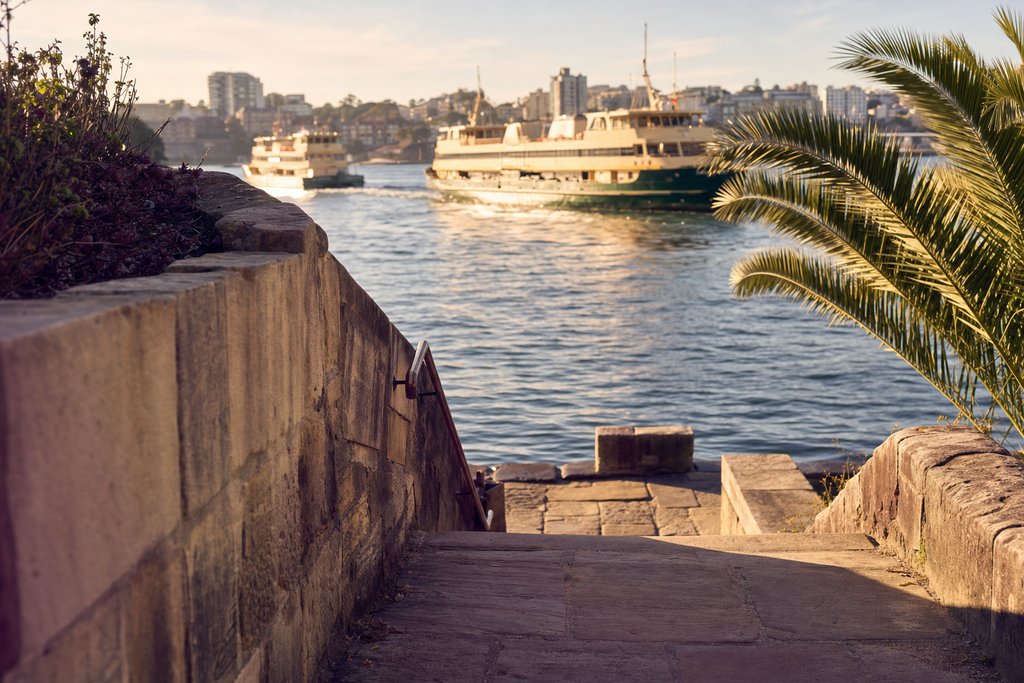
The cheapest good decision in Sydney: the Manly ferry from Circular Quay is a scheduled public transport service on an Opal fare, it takes thirty minutes, and it passes both the Opera House and the bridge from the water: the angle the harbour cruises charge for.
Sit on the right-hand side going out for the city, the left coming back for the heads. The afternoon return is the better light in both directions.
The coast
Bondi to Coogee coastal walk
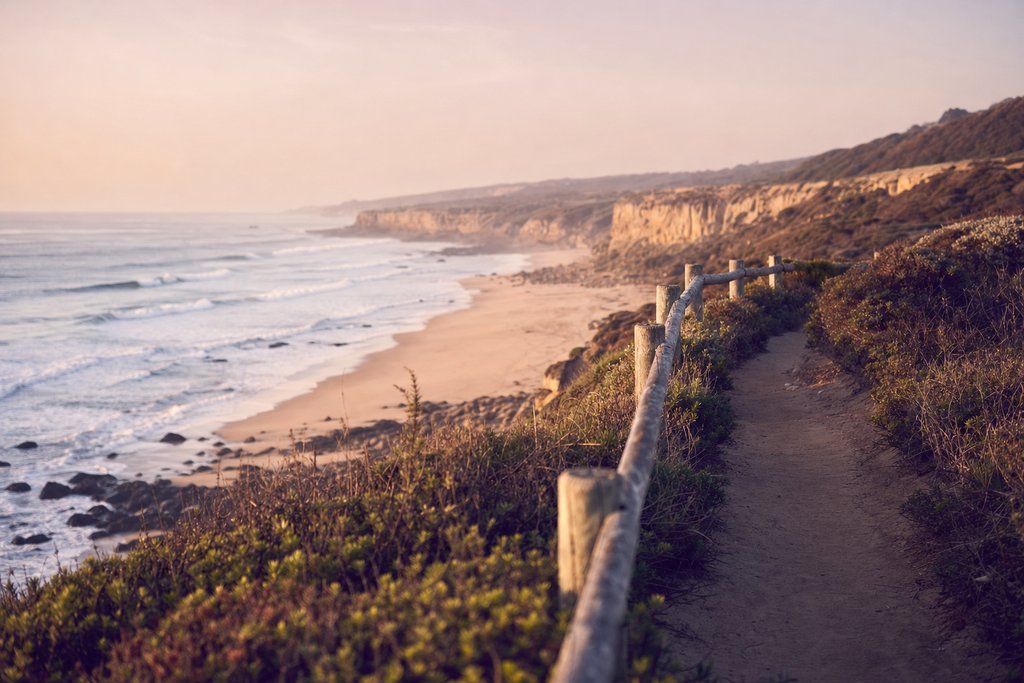
Six kilometres of cliff path south from Bondi through Tamarama, Bronte and Clovelly, about two hours one way with buses back from several points. Sandstone cliffs, ocean pools cut into the rock, and a completely different subject from the harbour.
Early morning again: the path faces east, the swimmers are in the pools from six, and by ten in summer it is crowded and harshly lit.
- Address
- Bondi Beach to Coogee Beach, Sydney
- Status
- Standing
- Access
- Open, free
- Checked
- Aug 2026
A one-day plan
- Sunrise at Mrs Macquaries Point.
- Breakfast at Circular Quay, then the Opera House forecourt close up.
- The bridge footway across to Milsons Point, late morning.
- Manly ferry out and back in the early afternoon.
- Blues Point Reserve for sunset and blue hour.
That leaves the coastal walk for a second morning, which is the right way round: doing both sunrises on consecutive days beats trying to fit the coast into the same day.
Practicalities
An Opal card or a contactless card covers trains, buses and ferries with a daily cap, which makes the ferry effectively free once you have travelled. Sydney's summer sun is severe and the harbour reflects it; the walk and the ferry are both exposed.
Tripods are restricted at the Opera House forecourt and some harbour foreshore sites, and drone flying over the harbour is prohibited without authorisation. The rest of the Australian material is in the Australia desk.
The harbour at each hour
Sydney Harbour runs roughly east to west and the two subjects everybody photographs sit at the eastern end. That geometry decides everything.
The other Australian subjects on this site work the same way: Whitehaven is a light problem before it is a beach, and the Melbourne laneways are a light problem before they are street art. The rest sits in the Australia desk.
| Hour | Where to be | Why |
|---|---|---|
| Sunrise | Mrs Macquaries Point | Sun behind you, sails lit, gardens empty |
| Mid-morning | Circular Quay, Opera House forecourt | Close work on the tiles and shells |
| Midday | The bridge footway, or indoors | Overhead light is flat everywhere else |
| Afternoon | Manly ferry | Both landmarks from the water, moving |
| Sunset / blue hour | Blues Point Reserve | Sun behind you again, city lights on |
The Opera House up close
Most photographs of the building are taken from six hundred metres away, and the interesting material is at arm's length. The shells are clad in over a million tiles in two finishes, a glossy white and a matt off-white, laid in a chevron pattern that only resolves as a pattern from a few metres. From a distance it reads as one surface; from the forecourt it is clearly two.
The other close subject is the podium: the broad flight of steps on the western side, which is where the building meets the ground and where the geometry of the shells is most legible. Both are free and neither requires a ticket.
Beyond the harbour
The Rocks
The sandstone laneways under the southern approach to the bridge, and the oldest built fabric in the city. Nurses Walk and Foundation Park give the narrow, stepped, shadowed compositions the harbour cannot. Best in the middle of the day, when the light reaches down between the walls.
- Address
- The Rocks, Sydney, NSW
- Status
- Standing
- Access
- Open
- Checked
- Aug 2026
Barangaroo Reserve
A reconstructed sandstone headland on the western side of the city, built over a former container terminal, with terraced rock and native planting. It is the newest public shoreline in Sydney and photographs unlike anywhere else on the harbour.
- Address
- Barangaroo Reserve, Sydney, NSW
- Status
- Standing
- Access
- Open, free
- Checked
- Aug 2026
Wendy Whiteley's Secret Garden, Lavender Bay
A garden made on disused railway land below the north shore, open, free, unsigned and steeply terraced down to the water. It is the one place on this list most visitors have not heard of.
- Address
- Lavender Bay, North Sydney, NSW
- Status
- Standing
- Access
- Open, free
- Checked
- Aug 2026
The ocean pools
Sydney has more than thirty tidal pools cut into the rock along its coast. Bondi's Icebergs is the famous one and is a private club with a viewing charge; Bronte, Coogee's Wylie's Baths and Mahon Pool at Maroubra are public and are better subjects.
- Address
- Eastern beaches, Sydney, NSW
- Status
- Standing
- Access
- Mostly open and free
- Checked
- Aug 2026
Rules that catch photographers out
- Tripods are restricted at the Opera House forecourt and on parts of the harbour foreshore managed as event space. Handheld is unrestricted.
- Drones may not be flown over the harbour, the bridge or crowds without authorisation, and the restriction is enforced.
- Commercial shoots on public foreshore need a permit; ordinary personal photography does not.
- The bridge climb permits no cameras or phones at all. The free footway alongside permits both, which is the better deal.
Weather and season
Sydney's summer is humid and thundery in the late afternoon, which produces excellent skies and occasional soaked equipment. Autumn, March to May, has the most stable light and the least wind. Winter is dry, clear and cool, with the sun low enough to be useful for longer, and is the most under-rated season for photographing the city.
The southerly buster is worth knowing about: a hard wind change that arrives in the afternoon in summer, drops the temperature ten degrees in twenty minutes and brings a sharp line of cloud across the harbour. It is the single most dramatic thing that happens in Sydney's sky and it is forecast.
Getting around with a camera
An Opal card or a contactless bank card covers trains, buses, ferries and light rail with a daily cap, and Sunday has a lower cap again. The ferries are covered by it, which makes the Manly run, thirty minutes each way past both landmarks, effectively free once the cap is reached.
The one thing to plan is the sunrise: the trains start early but not early enough for a midwinter sunrise at Mrs Macquaries Point from the outer suburbs. Staying in the city or the lower north shore makes the two sunrise shoots practical, and they are the two that matter.
Three walks that carry the whole city
The Bondi to Coogee coastal walk
Six kilometres south along the cliffs, about two hours one way, with buses back from Bronte, Clovelly and Coogee. Ocean pools, sandstone, and a completely different subject from the harbour. East-facing, so it is a sunrise walk.
- Where
- Eastern beaches, Sydney
- Time needed
- 2–3 hours
- Checked
- Aug 2026
The Hermitage Foreshore walk
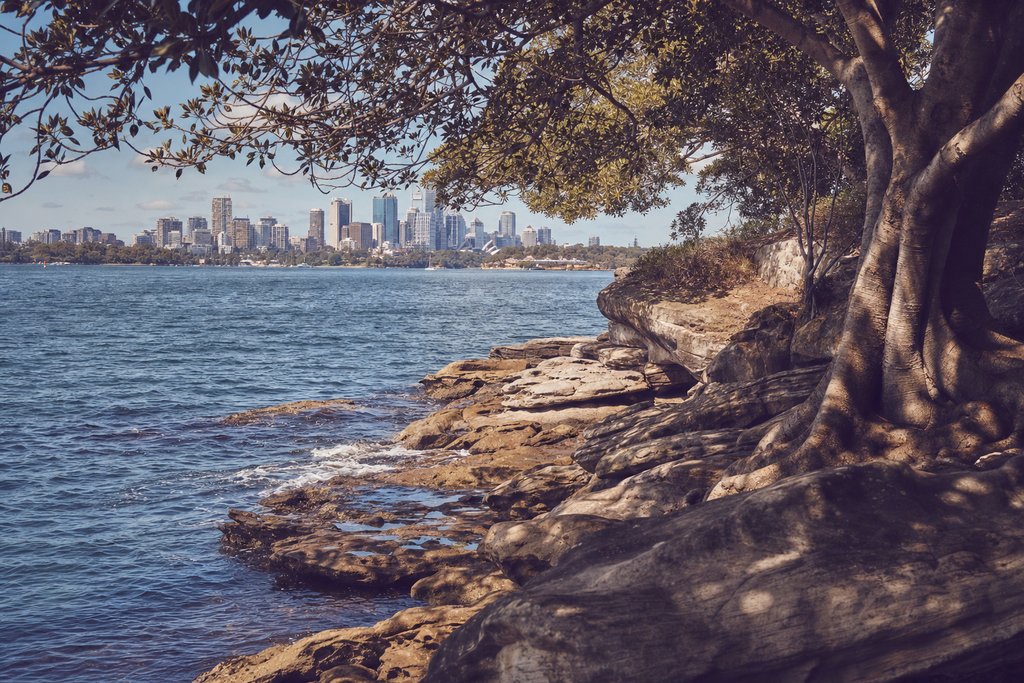
A short harbour-side track at Vaucluse with small beaches and the best low-angle view back to the bridge and the Opera House together. Twenty minutes, and almost nobody does it.
- Where
- Vaucluse, Sydney
- Time needed
- 1 hour
- Checked
- Aug 2026
Manly to Spit Bridge
Ten kilometres along the northern harbour foreshore through bushland, with Aboriginal rock engravings on the route and beaches most visitors never see. Four hours, and the ferry back from Manly finishes it properly.
- Where
- North Harbour, Sydney
- Time needed
- Half a day
- Checked
- Aug 2026
Getting the light right
Sydney is a hard-light city for most of the day. The sun is high, the sandstone is pale and the water throws it all back up. Three practical responses:
- Shoot the edges of the day. The first hour and the last are the only reliably good light, and blue hour on the north shore is the best twenty minutes in the city.
- Use the shade structurally. The Rocks and the fig avenues in the Botanic Garden give contrast that works at midday, when open ground does not.
- Overcast is not a loss. The harbour turns pewter and the Opera House tiles read as one surface, not two, which is a different and often better photograph.
A two-day plan
Day one, harbour: sunrise at Mrs Macquaries Point, breakfast at Circular Quay, the Opera House forecourt, the bridge footway across to Milsons Point, the Manly ferry in the afternoon, and Blues Point Reserve for sunset and blue hour.
Day two, coast: sunrise at Bondi, the coastal walk south to Coogee, a bus back, and the Hermitage Foreshore or the Botanic Garden in the late afternoon. Adding the Manly to Spit walk makes it three days, and it is the one most worth the extra day.
Frequently asked questions
Where is the best place to photograph the Sydney Opera House?
Mrs Macquaries Point in the Royal Botanic Garden gives the classic composition with the Harbour Bridge behind it, best at sunrise. Blues Point Reserve on the north shore gives the reverse angle in the afternoon, and the Manly ferry passes both without a queue.
When is the best light for Sydney Harbour photographs?
Sunrise from Mrs Macquaries Point, because the sun comes up behind you and lights the sails; late afternoon and blue hour from the north shore for the same reason in reverse. The middle of the day is flat and contrasty and is when almost everyone shoots.
Can you walk across the Sydney Harbour Bridge for free?
Yes. There is a public pedestrian footway on the eastern side, reached by stairs from Cumberland Street in The Rocks, and it costs nothing. The paid climb goes over the arch itself, which is a different experience at a very different price.
How do you get to Bondi and the coastal walk?
Train to Bondi Junction then a bus, or a bus the whole way from the city. The Bondi to Coogee coastal walk runs six kilometres south along the cliffs and takes about two hours one way, with buses back from several points.