Location file
Visit Bath: Start Your Tour Of The Cotswolds
Bath is a small city built almost entirely out of one stone, in one architectural language, over about seventy years. That is unusual enough to be the whole reason to go: it is a coherent Georgian composition, not a collection of good buildings, and walking it takes a day.
It is also routinely sold as a Cotswolds base, which is true for the southern end of the range and misleading for the northern. This file covers both; the city itself, and honestly which villages are within reach.
Bath in a day
The Roman Baths
A Roman bathing complex around a hot spring, buried and rediscovered, with the Georgian terrace built above it. The water still rises at around forty-six degrees and the Great Bath is open to the sky. It is the busiest attraction in the city; timed tickets and an early slot are the difference between seeing it and queueing in it.
- Address
- Abbey Church Yard, Bath BA1
- Status
- Standing
- Access
- Open, ticketed, timed
- Checked
- Aug 2026
Bath Abbey and the churchyard
The last great medieval church built in England, on the square beside the baths, with fan vaulting and a west front carved with angels climbing ladders. Entry is by donation and the tower tour is separately ticketed and worth it for the roof-level view over the city.
- Address
- Bath Abbey, Bath BA1
- Status
- Standing
- Access
- Open, donation; tower tour ticketed
- Checked
- Aug 2026
The Royal Crescent and the Circus
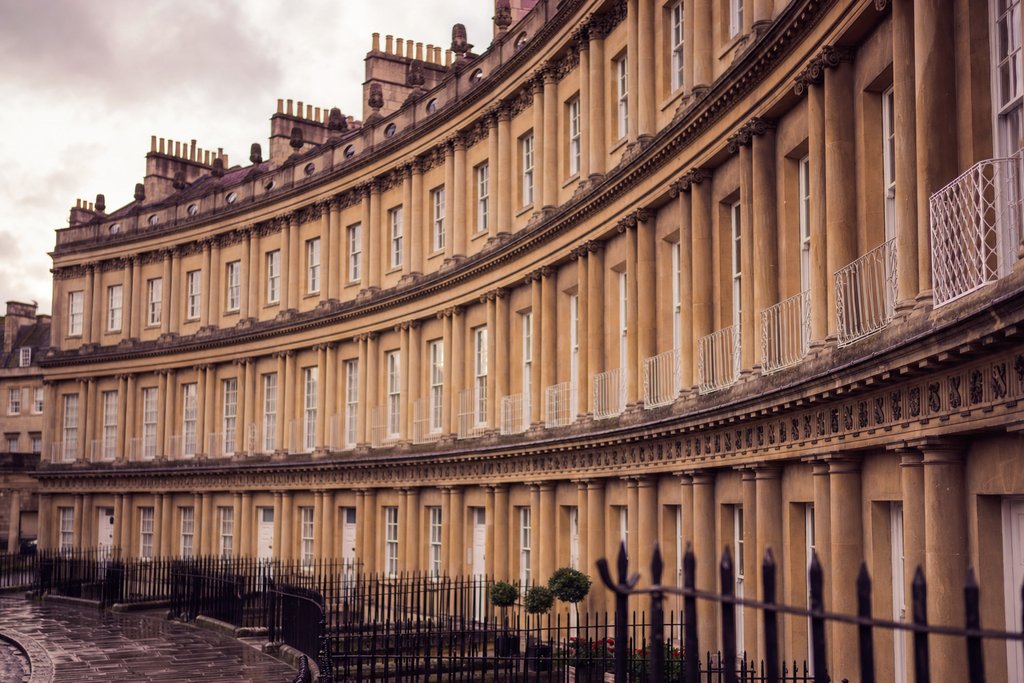
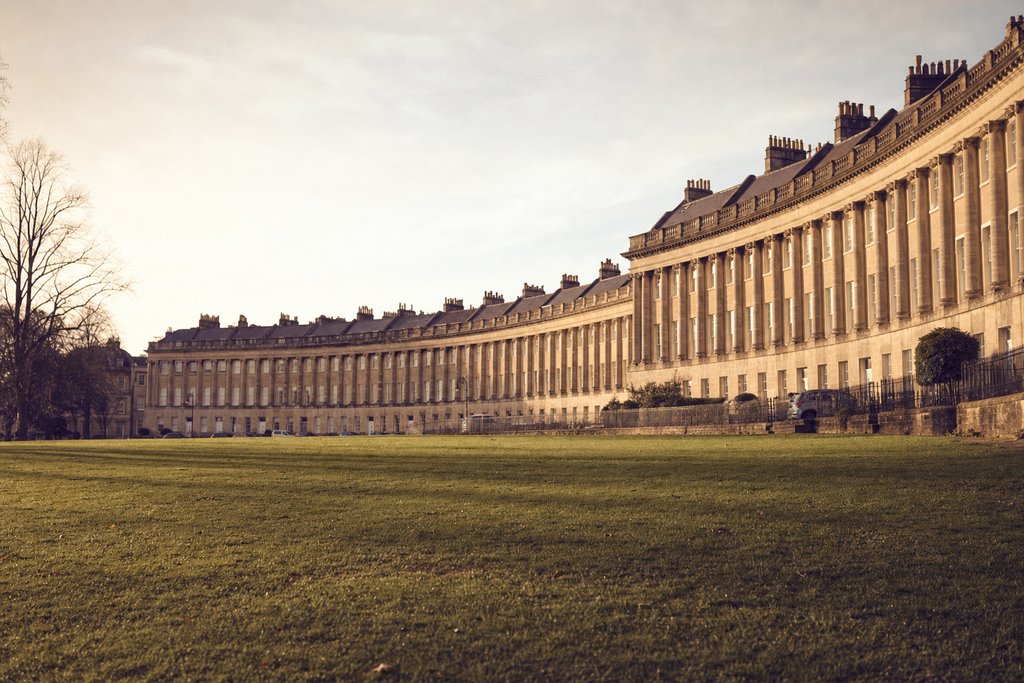
The two Georgian set pieces, ten minutes' walk uphill from the centre and connected by Brock Street. The Crescent is thirty houses behind one continuous facade above a sloping lawn; the Circus is a circle of three curved terraces around a stand of plane trees. Both are private residences and offices, with one house at the Crescent open as a museum.
- Address
- Royal Crescent and The Circus, Bath BA1
- Status
- Standing
- Access
- Exteriors and lawn open; No. 1 Royal Crescent ticketed
- Checked
- Aug 2026
Pulteney Bridge and the weir
One of a handful of bridges in the world with shops across its full span on both sides, above a horseshoe weir. The best view is from the riverside path below on the west bank, not from the bridge itself.
- Address
- Pulteney Bridge, Bath BA2
- Status
- Standing
- Access
- Open
- Checked
- Aug 2026
On screen
Bath's Georgian uniformity makes it a standing set for period drama, and the Crescent, the Circus and the Assembly Rooms appear regularly. Filming closes streets at short notice, usually in the early morning, and the city publishes notices in advance.
The practical consequence for a visitor is small but real: an early-morning walk up to the Crescent in production season may find it dressed with gravel and period lamp posts, which is either a bonus or an obstruction depending on what you came for.
Which Cotswolds are actually near
| Village | From Bath | Worth it? |
|---|---|---|
| Castle Combe | 30 min | Yes, the classic single-street village |
| Lacock | 30 min | Yes, village and abbey, heavily filmed |
| Tetbury | 45 min | Yes: market town, antiques |
| Bibury | 1 hr 10 | Marginal from Bath |
| Bourton-on-the-Water | 1 hr 30 | No, base further north |
| Broadway | 1 hr 45 | No, base further north |
The honest summary: Bath is an excellent base for the southern Cotswolds and a poor one for the northern. If the northern villages are the point of the trip, stay at Cirencester, Stow-on-the-Wold or Chipping Campden and visit Bath as a day out instead.
Practicalities
- Getting there: ninety minutes by train from London Paddington to Bath Spa, and the station is a five-minute walk from the centre.
- Driving: Bath has a clean air zone charging some vehicles, expensive and limited parking, and steep narrow streets. Park and ride is the sensible option.
- Cotswolds by bus: possible to a few of the larger villages and slow. For a village-hopping day a car is close to essential.
- Season: Bath is busy from Easter to October and at Christmas, when the market fills the Abbey churchyard. February is quiet, cheap and cold.
The one-day and two-day versions
One day: Roman Baths first thing on a timed ticket, the Abbey, lunch, then uphill to the Circus and the Royal Crescent, back down via the Assembly Rooms and along to Pulteney Bridge at the end of the afternoon.
Two days: add the Fashion Museum, the Holburne, a walk along the canal towpath, and a half-day loop by car to Castle Combe and Lacock. That combination is the best use of Bath as a base, and it is a fuller trip than pushing north to villages an hour and a half away.
The rest of the British material is in the UK & Ireland hub. Bath is a standing period set as much as a city, which is the same reason the location index carries it, and the wider European material is in the Europe hub.
Why the city is one colour
Bath stone is an oolitic limestone quarried on the hills immediately south of the city, and for the seventy years of the Georgian rebuilding it was the cheapest material available. Everything was built from it: the crescents, the terraces, the churches, the walls, the paving.
That is why the city reads as a single composition rather than a collection of buildings, and it is also why it weathers as one. The stone is soft, it darkens with soot and lightens when cleaned, and the uniformity of tone across a whole street is a consequence of every block coming out of the same ground.
The practical consequence for a visitor is that Bath photographs best in low, warm light: early morning or the last hour: when the stone reads gold, not grey. Under flat overcast it loses most of what makes it distinctive.
The Georgian set pieces in order
Queen Square, the Circus and the Royal Crescent
The three are one composition by the same family of architects, connected by Gay Street and Brock Street, and walking them in that order is the way they were meant to be seen: a square, then a circle, then a crescent opening onto a landscape. The whole sequence takes twenty minutes on foot and rises steadily uphill.
- Address
- Queen Square to Royal Crescent, Bath BA1
- Status
- Standing
- Access
- Streets and lawn open; houses private
- Checked
- Aug 2026
The Assembly Rooms
The eighteenth-century public rooms where Bath society met, gutted by bombing in 1942 and rebuilt inside the surviving shell. Opening has varied in recent years with conservation work, so check before relying on it.
- Address
- Bennett Street, Bath BA1
- Status
- Changed (interior rebuilt post-1942)
- Access
- Open, ticketed, subject to works
- Checked
- Aug 2026
Great Pulteney Street and the Holburne
Across Pulteney Bridge, a very wide Georgian street running dead straight to a museum at the far end. It is the least visited of the set pieces and the one that best shows the scale the speculative builders were working at.
- Address
- Great Pulteney Street, Bath BA2
- Status
- Standing
- Access
- Open; museum ticketed
- Checked
- Aug 2026
The baths, and the thermal water
The spring delivers about a million litres a day at roughly forty-six degrees, and it has been doing so since long before the Romans built over it. The Roman complex is a museum: the water in the Great Bath is untreated and cannot be entered.
Bathing in the same water is possible at the modern thermal spa a short walk away, which draws from the same source, treats it, and has a rooftop pool with a view over the abbey. The two are separate tickets and separate experiences, and doing both in a day is a reasonable plan; the museum in the morning, the spa in the late afternoon.
The museum operates timed entry and is busiest between eleven and three. The first slot of the day is materially better.
Eating and staying
Bath is expensive and small, which is a difficult combination in season. Two practical displacements: stay outside the centre at Widcombe or Bathwick and walk in over the river, and eat away from Abbey Green and the Roman Baths where the pricing is set by footfall rather than by cooking.
The city keeps two long-running food institutions worth knowing about: the Sally Lunn bun, a large light enriched roll served split with sweet or savoury toppings, and the Bath Oliver, a hard plain biscuit invented as a physician's remedy. Both are more interesting historically than gastronomically, and both are easy to try.
The southern Cotswolds, village by village
Castle Combe
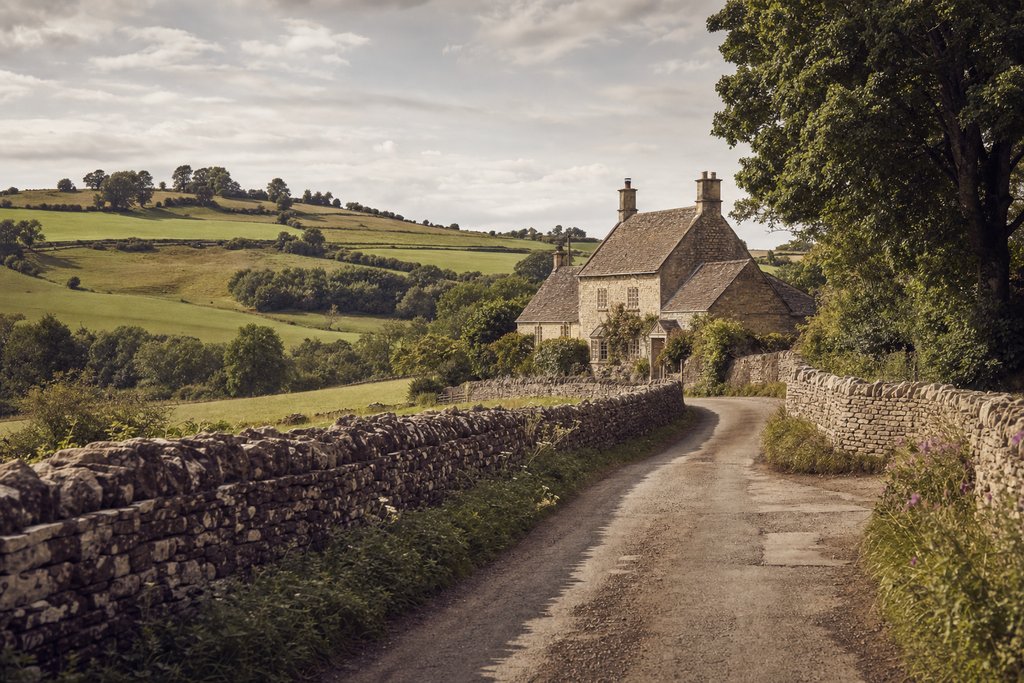
A single street of honey stone cottages down to a bridge, with no visible modern intrusion: which is why it is filmed constantly. Parking is in a car park above the village and the walk down is five minutes. Thirty minutes from Bath.
- Where
- Castle Combe, Wiltshire
- Time needed
- 1 hour
- Checked
- Aug 2026
Lacock
A National Trust village where the whole settlement is owned and maintained by the trust, plus an abbey with a cloister. Heavily used as a period location for the same reason as Castle Combe. Thirty minutes from Bath.
- Where
- Lacock, Wiltshire
- Time needed
- Half a day with the abbey
- Checked
- Aug 2026
Tetbury and Malmesbury
Two working market towns, not preserved villages, with antique shops, a Norman abbey at Malmesbury and considerably fewer visitors. Forty-five minutes.
- Where
- Gloucestershire and Wiltshire
- Time needed
- Half a day
- Checked
- Aug 2026
Practical notes
- Rail: ninety minutes from London Paddington to Bath Spa, and the station is five minutes from the abbey. Bristol is fifteen minutes away by train.
- Driving: Bath operates a clean air zone that charges some vehicles, and the central streets are narrow, steep and one-way. Park and ride from three sites on the edge of the city is the sensible option.
- Walking: the city is hilly. The Royal Crescent is a genuine climb from the abbey, and the skyline walk above the city is a proper hike.
- Season: busy from Easter to October and again for the Christmas market, which fills the abbey churchyard for about three weeks in December. February is cold, quiet and much cheaper.
Walking above the city
The Bath Skyline is a six-mile National Trust circuit through woodland and meadow on the hills east of the centre, with views down over the whole Georgian composition. It starts a fifteen-minute walk from the abbey, it is free, and it is the best two and a half hours available in the city.
Shorter alternatives: the canal towpath along the Kennet and Avon east from the city, level and step-free, and the climb up to Alexandra Park on the southern hill, which gives the postcard view in twenty minutes.
A note on the crowds
Bath receives several million visitors a year into a very small centre. The pressure is concentrated between eleven and four around the abbey and the baths, and it thins completely two streets away. Early morning and the hour before dusk are a different city, and they are also the only times the limestone gets the low light it was built for.
Frequently asked questions
Is Bath a good base for the Cotswolds?
For the southern Cotswolds, yes: Castle Combe, Lacock and the villages around Tetbury are within forty minutes. For the classic northern villages such as Bourton-on-the-Water and Broadway it is an hour and a half each way, and Cirencester or Stow-on-the-Wold are better bases.
How long do you need in Bath?
A full day for the Roman Baths, the Abbey and the Georgian set pieces, or two if you want the Fashion Museum, a walk up to the Royal Crescent lawn and time on Pulteney Bridge without hurrying. The centre is small and entirely walkable.
Do you need a car in Bath?
Not in the city; it is compact, walkable and has bad, expensive parking, plus a clean air zone charge for some vehicles. For the Cotswolds a car is close to essential, because rural bus services are sparse and slow.
Why is Bath the colour it is?
Bath stone: a honey-coloured oolitic limestone quarried locally and used almost universally in the Georgian rebuilding of the city. The uniformity is a consequence of one material being cheap and available, and it is why the city reads as a single composition.